Buying a Saree Online? 7 Details to Check Before You Order
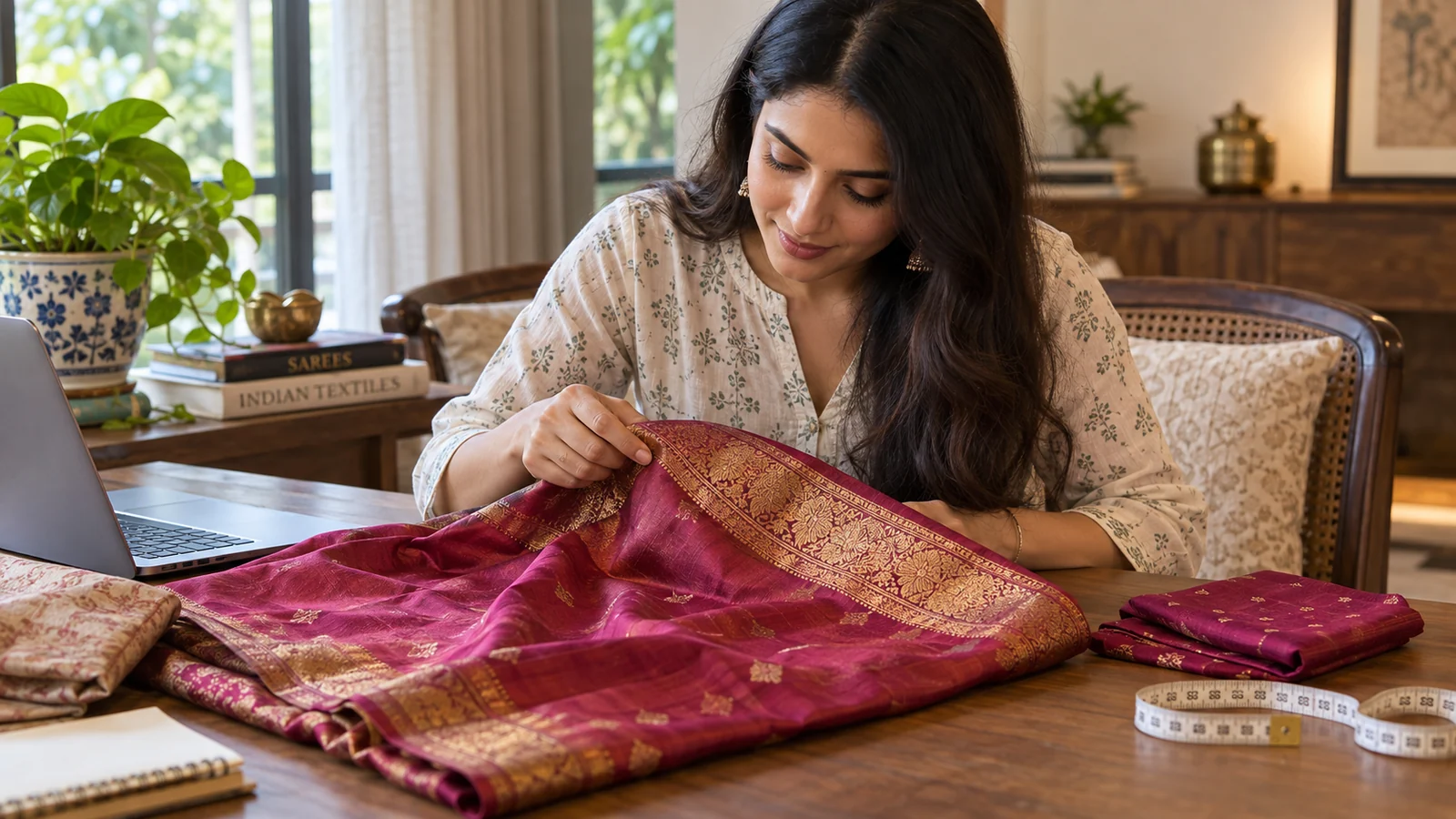
The tricky part about buying a saree online is not finding something beautiful. It is understanding exactly what you are looking at before you place the order.
A product photo can show you the colour, drape and overall look. But it may not answer the questions that matter once the saree reaches you: What is the fabric? How long is it? Is a blouse piece included? Is the work embroidered, printed or zari? Does it need special care?
A good listing should help you answer those questions without making you guess. Here are seven details worth checking before you choose a saree online.
1. Start with the fabric — not just how it looks in the photo
Fabric is one of the first details to check because it affects how a saree falls, feels and behaves when you wear it.
The important thing is to read the actual fabric information instead of identifying it from the photograph. A saree can have a silk-like sheen without being silk, and two fabrics with a similar finish can drape very differently.
Look for a clear fabric field and, where available, a little more detail about the material. If the listing says only something broad such as “Silk”, but the exact variety or composition matters to you, treat that as something to confirm rather than filling in the gap yourself.
The same applies to words such as “pure”, “handloom”, “Tussar”, “Dupion” or a specific weave. If that distinction is important to your purchase, it should be clearly supported by the product information rather than assumed from the title or pictures.
A useful question to ask yourself: Do I know what the saree is made from, or am I guessing from the way it looks?
2. Check the saree length — and what that number includes
Length can be easy to overlook when the product photos look right.
A listing may show a measurement such as 5.5 m, 6.3 m or another figure. The number on its own does not always tell you whether it refers only to the saree fabric or to the total fabric supplied along with a blouse piece.
For example, a listing could supply a saree and a separate blouse piece. In that case, you want to know whether the displayed measurement describes the saree alone or the combined fabric.
That matters for practical reasons: your drape, height, pleats and styling preference can all affect how comfortable you are with the available length.
On The Gallore, look for the Saree Length field on the product page. If the measurement still leaves something unclear, confirm it before ordering rather than assuming that every seller measures the product in exactly the same way.
Before you order: Know the stated length and know what the seller means by it.
3. “Blouse piece included” does not mean “stitched blouse included”
This is one of the easiest details to misread while shopping online.
If a product says Blouse Piece Included: Yes, it usually tells you that fabric for a blouse is supplied with the saree. It does not automatically mean you will receive a ready-to-wear stitched blouse.
Those are very different things.
Before buying, check whether the listing tells you:
- whether a blouse piece is included;
- whether it is separate or attached to the saree fabric;
- whether any blouse shown in the photos is part of the product or simply used for styling; and
- whether tailoring is still required.
If the listing does not say, do not use the model photo as proof that a stitched blouse comes with the order.
This small check can save a surprisingly large amount of confusion after delivery.
4. Read the work details, then look at the close-up photos
A full-length image tells you how the saree looks as an outfit. Close-up images tell you much more about the surface.
If the listing mentions embroidery, zari, sequins, print, motifs or another type of work, look for photographs that let you inspect the border, pallu and detailed areas.
You are trying to answer two different questions:
What does the seller say the work is? and Do the photos help me understand where that work appears and how prominent it is?
Photos are useful for scale and placement. They are not a substitute for written product information.
For example, a gold-toned border in an image should not automatically be treated as proof of a particular zari type. Similarly, a printed pattern and hand-applied work can look quite convincing from a distance. If the technique itself matters to you, rely on the stated details or ask before ordering.
5. Use photos to judge the look — but allow for colour differences
When you shop online, colour is being filtered through several things before it reaches you: studio or room lighting, the camera, editing, your display and your screen settings.
That does not make product photography useless. It simply means it is better to use multiple images together instead of judging a saree from one hero shot.
Look for:
- a full view of the saree;
- a closer view of the fabric;
- border and pallu details;
- blouse-piece photos when a blouse piece is included; and
- photographs taken from more than one angle.
If the listing has several colour variants, make sure you know which variant you are selecting rather than relying only on the first image.
And if a very precise shade matters — perhaps because you are matching jewellery, a blouse or a family colour theme — leave a little room for screen-to-screen variation.
6. Check the care requirements before the first wear
Care is not the most exciting part of buying a saree, but it is useful information to know before purchase.
A saree with delicate embroidery or embellishment may need different handling from a straightforward everyday fabric. Some products may recommend dry cleaning, gentle storage or avoiding certain kinds of washing.
Do not invent a care routine from the fabric name alone. If care instructions are available on the listing, follow those. If they are missing and the saree has delicate work, ask the seller before washing or treating it at home.
It is also worth thinking one step ahead: Will the saree need fall and pico, blouse stitching, steaming or another preparation before the event you are buying it for?
That helps you plan the purchase around the day you actually need to wear it.
7. Read the delivery and return information before making alterations
When you find a saree you like, it is tempting to move straight from delivery to tailoring.
Before doing that, check the delivery and return information that applies to your order.
Return eligibility can depend on the product, its condition and the applicable order terms. Alteration, stitching, damage, missing tags or other changes may affect what can be returned, depending on the policy that applies.
The safest habit is simple: inspect the saree when it arrives, compare it with the listing, and read the applicable return information before making any irreversible changes.
If you are shopping for a wedding or another date-specific occasion, also leave enough time for delivery and any tailoring you plan to do afterwards.
A quick checklist before you buy
Before placing the order, see whether you can answer these seven questions:
- What is the fabric?
- What is the saree length, and what does that measurement include?
- Is a blouse piece included?
- What work, print or embellishment is present?
- Do the photos show enough detail for you to understand the product?
- Do you know how the saree should be cared for?
- Have you checked the delivery and return information that applies to the order?
If several of those answers are still unclear, it is worth checking the listing again or asking before you buy.
Compare the details, not just the first photo
A saree is a visual purchase, but the best online buying decisions usually come from combining the photographs with the product details.
Start with the look you like. Then check the fabric, measurements, blouse information, work and practical details before making your final choice.
Ready to compare the details?
Explore sarees on The Gallore